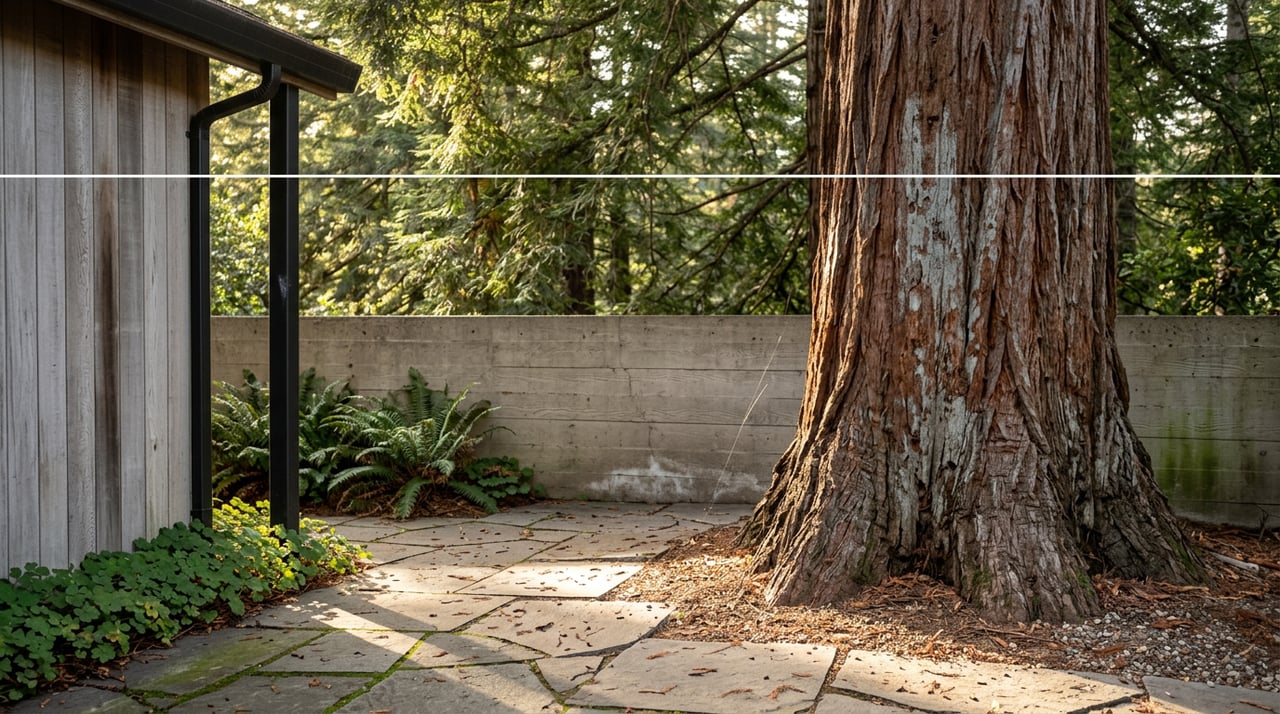
In May of this year, the Mill Valley Planning Department opened a file on a single tree. Not a project, not a subdivision, just one coast redwood at 448 Throckmorton Avenue, measuring 46 inches in diameter and standing roughly 65 feet tall. The staff report, dated May 19, 2026, walked through the standard findings: the tree qualified as a heritage specimen under the city's municipal code, the removal request was categorically exempt from further environmental review, and a Zoning Administrator would need to sign off before anyone touched it.
That is the whole story for most people who read the agenda. For anyone about to list a home in Mill Valley, it is the beginning of a different one. The tree ordinance here does not pause for a pending sale, an accepted offer, or a buyer's inspection contingency. It runs on its own calendar, and in a market where homes are going under contract in under two weeks, that calendar can quietly become the thing that decides your timeline.
The Rule Most Escrows Never Test
Mill Valley's Chapter 20.67 protects four species by name: coast redwood, oak, tanbark oak, and madrone, plus any tree the city has designated as heritage through a development approval. The thresholds are specific. Any tree over 12.5 inches in circumference cannot be removed from a vacant lot without a permit. On a developed lot, cutting four or more non-heritage trees in any 12-month period triggers the same requirement. The city's own summary states plainly that the goal is protecting the community's wooded character, not adding paperwork for its own sake, but the paperwork is real either way.
The ordinance is candid about why it exists.
"The uncontrolled removal or destruction of these trees threatens to adversely affect scenic beauty, destroy wildlife habitat, reduce privacy, and increase the risk of erosion, mudslides and flooding."
That language matters because it shapes what the Zoning Administrator can approve. Removal has to satisfy a specific finding, usually health, safety, or a public utility need. A homeowner who simply wants a better view or more sun on the patio does not get an automatic yes, and the code says so directly: topping a tree for view improvement is not allowed.
The Math That Flips the Intuition
Here is the part most sellers do not expect. The ordinance's replacement formula does not treat all removals the same. For every six inches, or fraction of six inches, of the diameter of a removed tree, the code requires three replacement trees of the same genus and species, planted on site, at a minimum 24-inch box size, using stock native to Marin County.
Run that formula on a tree the size of the redwood in the Throckmorton file. A 46-inch diameter divides into eight six-inch increments, rounding up for the fraction, and each increment calls for three trees. That is 24 replacement trees, on a residential lot, if the standard formula were applied in full. The city has discretion to adjust based on site conditions, but the math itself is public record, and it points to a conclusion most people get backward. The intuition is that a small scrubby tree is the safe one to remove and a grand old specimen is the one you leave alone out of respect. The ordinance's own arithmetic says the opposite: the bigger and older the tree, the larger the on-site planting obligation if you take it down. On a typical Mill Valley lot, finding room for two dozen new trees is its own project.
What the Permit Clock Actually Looks Like
| Step | What it involves | Typical timeframe or cost |
|---|---|---|
| Arborist report | Required for heritage tree removal requests tied to health or safety | $300 to $1,200 depending on scope |
| Permit application review | City review of a private tree removal permit | Up to 30 days, per the city's own processing guidance |
| Public notice | Mailed to property owners within 300 feet of the site, posted on the tree itself | 10 days before a decision takes effect |
| Appeal window | Any interested party can appeal the Director's or Zoning Administrator's decision | 10 calendar days from the decision |
| Removal cost | Varies by size, access, and whether rigging is needed for a large hillside specimen | Roughly $1,800 for standard access up to $20,000 or more for a large heritage tree |
| Unpermitted removal fine | Minimum penalty or the tree's appraised replacement value, whichever is greater | $5,000 minimum per tree, doubling for a repeat violation within 24 months |
Add those numbers together and a straightforward heritage tree removal, done correctly, can run 30 to 45 days before a chainsaw is ever involved. That is longer than many Mill Valley homes spend on the market right now.
Why This Matters More in a Market Like This One
Mill Valley's first half of 2026 was not a slow season. The average sale price climbed to $2,896,000, up from $2.6 million in the second half of 2025, and homes above the $2 million mark saw the strongest gains. Roughly two-thirds of homes sold above their asking price, up from a little over half the prior half-year, and the average premium paid over asking rose to nearly 13 percent. Nearly half of all sales drew multiple offers.
That pace is good news for sellers, but it changes the math on tree permits. If a home needs a heritage tree addressed before it can be shown well, or a buyer's inspector flags a leaning limb near the roofline during a short contingency period, the seller is now racing a 30-day city process against a market that expects an accepted offer within two weeks. The sellers who come out ahead are the ones who get the arborist walk-through done before the listing photos are scheduled, not after an offer is already on the table. A pre-listing arborist report turns a potential delay into a line item the seller already priced in.
If You're Buying Instead of Selling
The same clock applies after closing, and it is worth knowing before you write an offer. A lot marketed as needing a landscape refresh may simply be a property where the current owner has been maintaining compliance for years rather than avoiding an obvious problem. Conversely, a beautifully wooded lot with mature redwoods along the property line means any future addition, pool, or view corridor you have in mind will run through the same 20.67 review that governs any other removal in the city.
A useful reference point sits just outside city limits, on a vacant parcel in the unincorporated Tamalpais area. A pending Marin County tree removal permit there covers 11 trees, five California bay and six coast live oak, based on an arborist report and tree inventory prepared for the project. The filing shows the level of documentation a larger removal requires even when a lot has no existing structure on it. If you are buying raw land or a fixer with an eye toward serious redevelopment, that same documentation burden follows the property, not the owner.
A few removals fall outside the full heritage process:
- Trees below the circumference threshold on a developed lot
- Routine pruning that does not amount to topping or major structural alteration
- Emergency removal when a tree poses an immediate threat to people or property, which the Director of Planning and Building can approve on the spot
- Removal conducted by utility personnel from PG&E or the Marin Municipal Water District under their own emergency authority
Everything else goes through the standard review, arborist report and all.
A Few Questions We Get Often
Does a past or pending tree removal permit need to be disclosed when selling? Any known code violation or open enforcement matter is the kind of material fact a seller should discuss with their agent well before listing. This is general practice guidance, not legal advice, and a seller with specific questions about disclosure obligations should talk to a real estate attorney.
What if the tree in question sits on a shared property line? The city is direct about this one. Its own compliance FAQ states that property line disputes and neighbor disagreements are handled through civil channels, not the Planning Department. The tree ordinance governs the removal itself, but a boundary dispute is a separate conversation.
Is there a faster path if the tree is clearly dead or hazardous? Yes. The Director of Planning and Building can issue an emergency removal permit when a heritage tree poses an immediate threat to safety, which waives the standard review timeline. It is still worth documenting the hazard with a certified arborist so there is a clear record if questions come up later.
A tree ordinance is not the kind of thing that shows up on a listing sheet, but in Mill Valley it belongs in the same early conversation as pricing and staging. If you are weighing a sale this year, or looking at a wooded lot with plans of your own, Tiffany Knef can walk the property with you before the for sale sign goes up, so the tree conversation happens on your schedule instead of the city's. Schedule a free consultation to talk through what your specific lot and timeline actually require.